Latest News
Recent company updates and announcements
Current releases, milestones, event participation, and other updates published by Urbit.

Urbit One unifies field devices, edge nodes, connectivity, management, and integration into a resilient operating model for assets that cannot depend on perfect power, perfect networks, or frequent physical access.
Remote sites stop behaving like isolated points in the field. Existing infrastructure gains new digital value. Field data becomes usable operational intelligence.
Designed for industrial environments where assets are heterogeneous, communications vary from site to site, and resilience matters.
Securely connect assets and bring visibility, control, and integration into one place.
A techno-executive infographic showing how Urbit One moves data, decisions, and control from the field to enterprise systems through one operational platform.
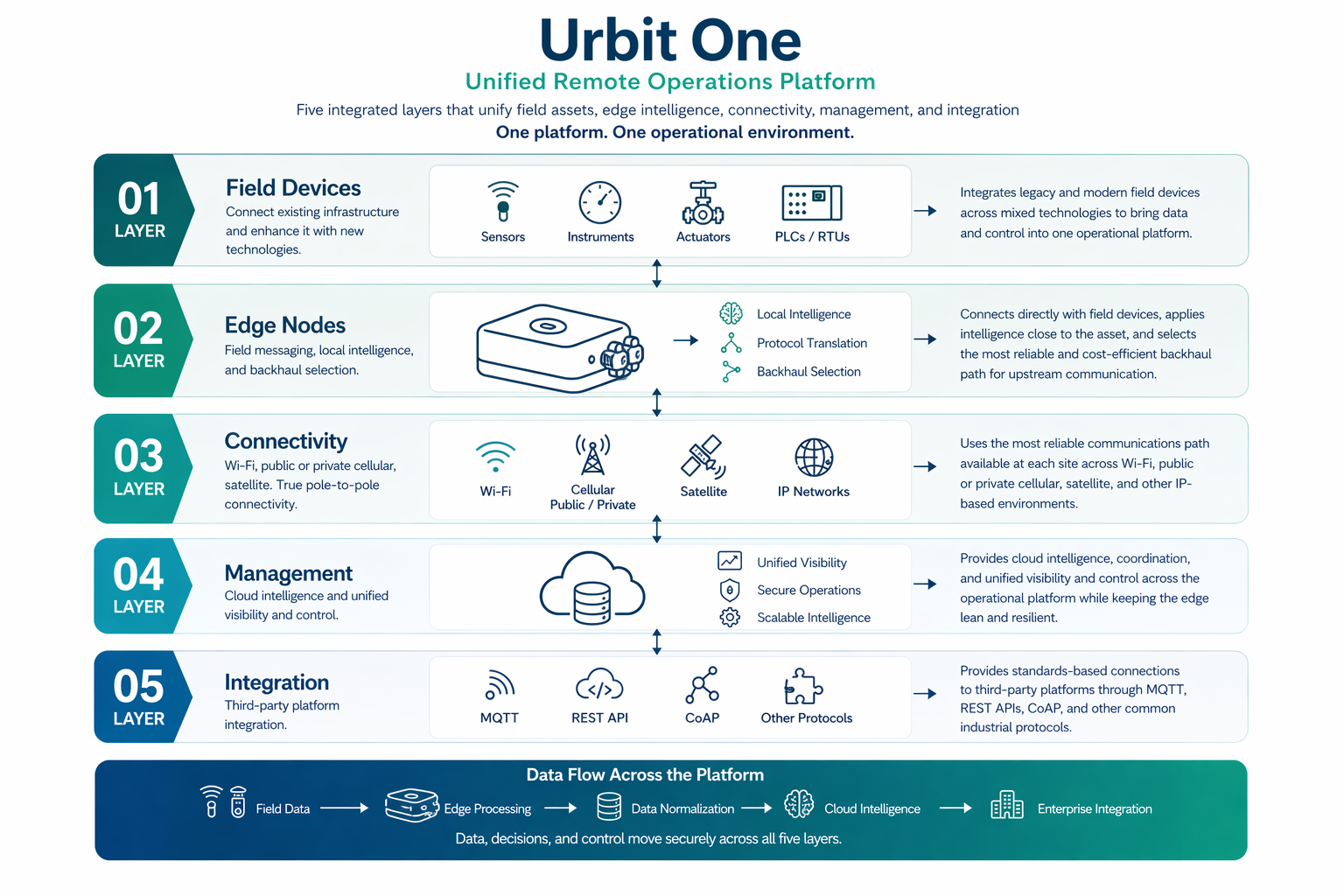
Urbit One is structured as a five-layer industrial platform that unifies field devices, edge nodes, connectivity, management, and integration into one operational platform.
Urbit One integrates sensors, actuators, instruments, and remote or unattended assets across legacy and modern technologies. This allows customers to preserve current infrastructure while adding new digital capabilities over time.
Urbit One Edge Nodes exchange messages with field devices, apply local intelligence, and select the most reliable and cost-efficient backhaul for upstream communication.
Urbit One uses the most reliable communications path available at each site, across Wi-Fi, public or private global cellular, satellite, and other IP-based environments.
Urbit One Management provides cloud intelligence, coordination, and unified visibility and control across the operational platform while keeping the edge lean and resilient.
Urbit One Integration provides the standards-based connection to third-party platforms through MQTT, REST APIs, CoAP, and other common protocols.
Executive infographic for the Urbit One platform architecture.
Bring legacy and modern assets into one platform.
Move data, logic, and response through the right layer.
Gain unified visibility and action across distributed sites.
Add new assets and sites without rebuilding the model.
These examples show how Urbit One Platform can be adapted to different industrial environments through one consistent operating model. They are representative deployment scenarios, not fixed prebuilt applications.
These grid examples show how Urbit One can help electric utilities connect field assets, operate across mixed communications environments, and unify monitoring, control, and integration across distributed power infrastructure.
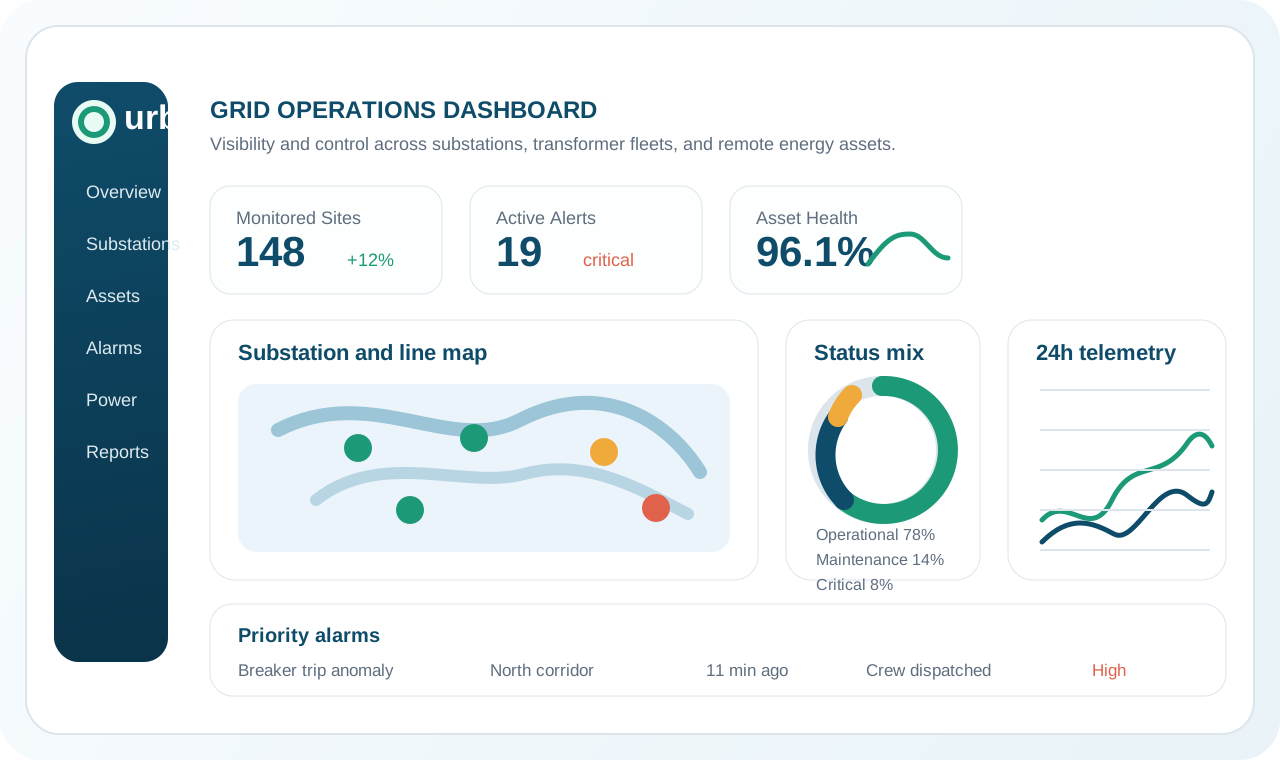
Monitor environmental conditions, backup systems, communications health, and critical operating indicators across remote substations.
Collect field telemetry from distributed transformer assets and bring it into one centralized operational environment.
Extend visibility into distributed grid infrastructure where field access can be limited and connectivity conditions vary.
Support faster awareness and more coordinated response across distributed grid environments by improving operational visibility.
Supervise batteries, power systems, and related remote assets with a platform designed for unattended environments.
Integrate site conditions, presence, doors, smoke, and other field signals into a centralized operating model.
These water examples show how Urbit One can connect remote water infrastructure across mixed communications environments and unify monitoring, control, and integration for distributed operations.
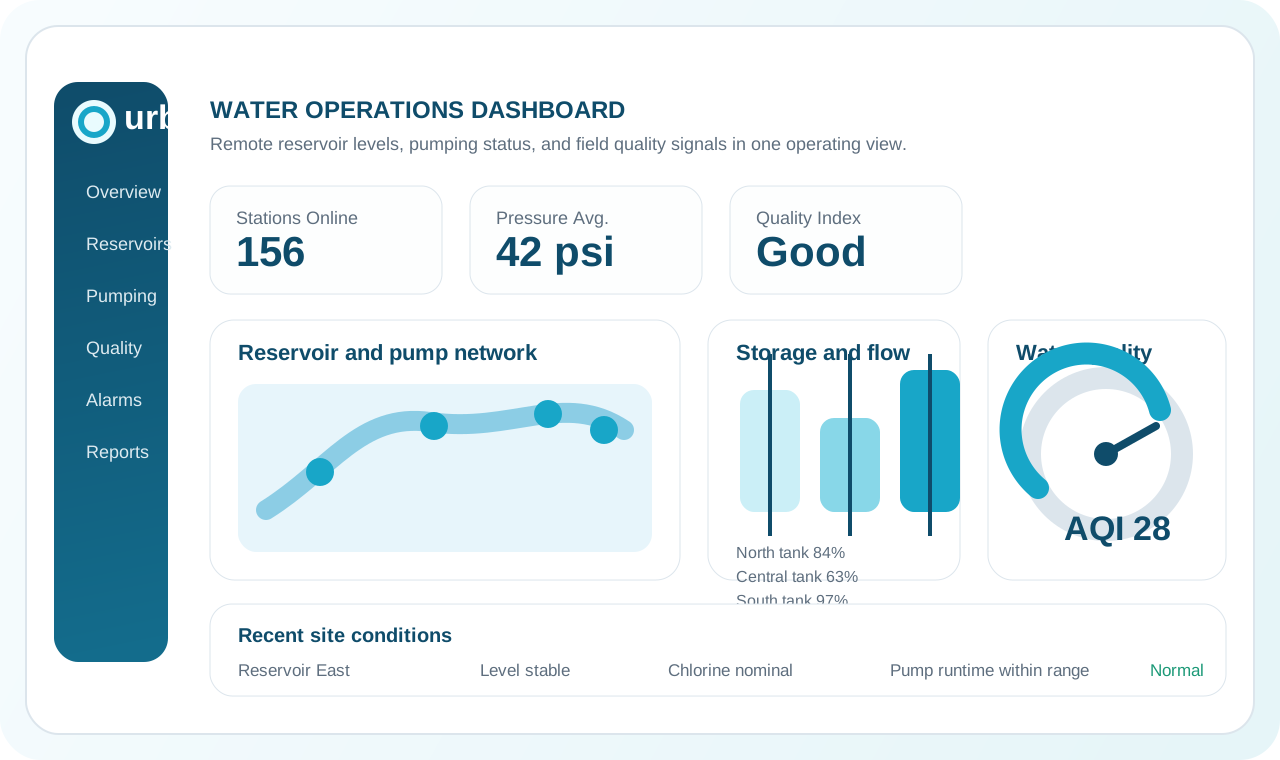
Track levels, conditions, communications health, and related field status across remote reservoirs and storage assets.
Supervise pump operation, alarms, runtime, and related field signals across distributed pump stations.
Collect telemetry from storage assets and bring it into one unified operational environment.
Improve awareness and response across remote water infrastructure with centralized alarms and event visibility.
Integrate chlorine, pressure, flow, and other key process indicators into one operating model.
Monitor doors, power, smoke, intrusion, and environmental conditions across remote water sites.
These oil and gas examples show how Urbit One can connect remote production and midstream assets, operate across mixed communications environments, and unify monitoring, control, and integration across critical field operations.
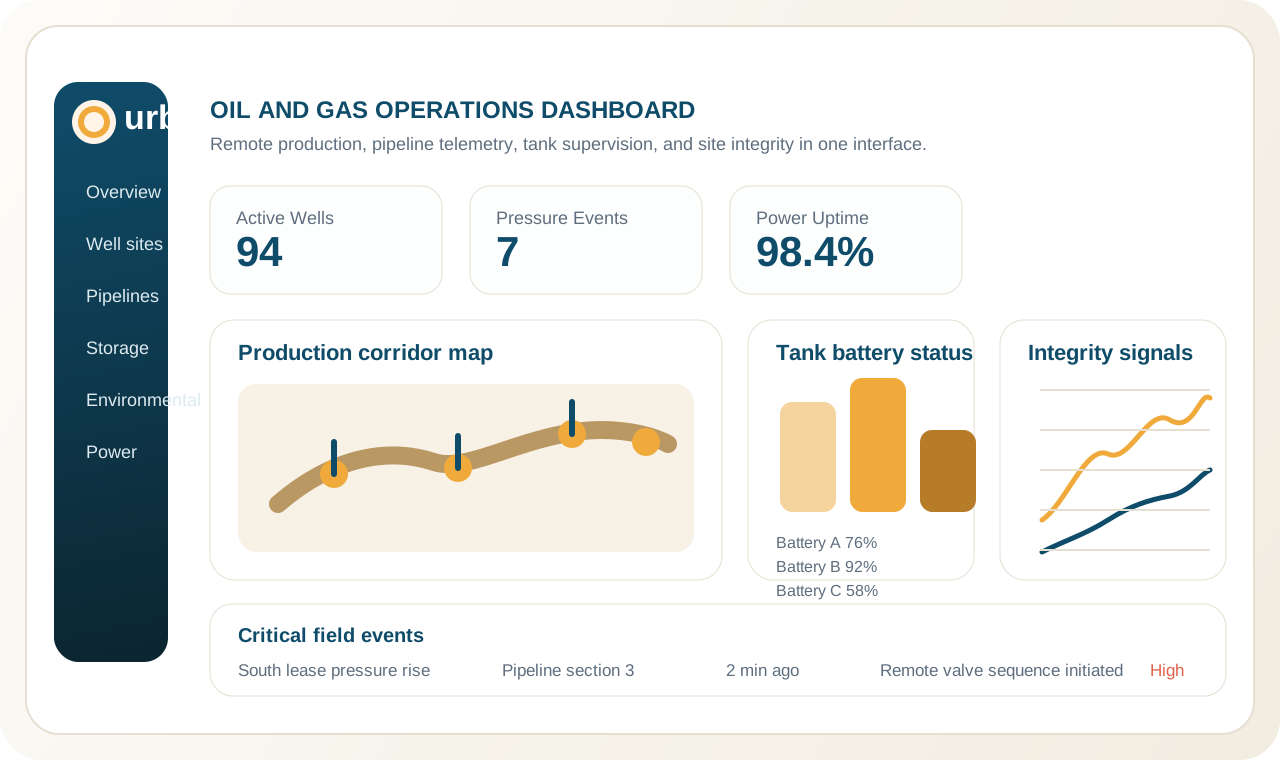
Monitor production status, pressures, tank levels, power systems, and site conditions across remote well locations.
Collect flow, pressure, and operational telemetry from distributed pipeline and transfer assets.
Bring storage, alarms, communications health, and equipment status into one centralized operational view.
Integrate leak detection, gas presence, and site environmental signals into one operational platform.
Supervise solar, batteries, generators, and related remote power infrastructure supporting field operations.
Support faster awareness and coordinated response across high-value remote production environments.
These telecom examples show how Urbit One can connect distributed communications infrastructure and unify monitoring, control, and integration across tower sites, shelters, backup power, and remote network assets.
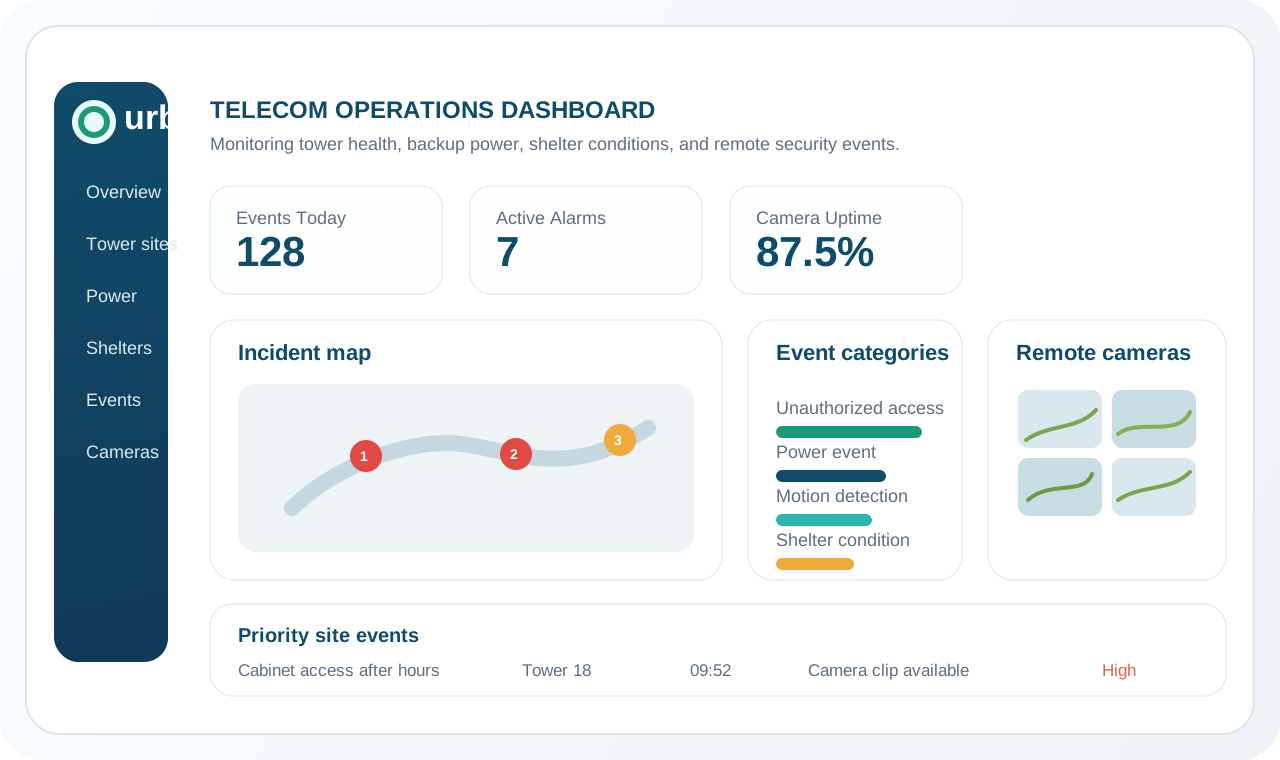
Monitor power systems, shelter status, communications health, and critical alarms across distributed tower sites.
Track batteries, rectifiers, generators, and related backup systems supporting remote telecom infrastructure.
Integrate temperature, intrusion, smoke, doors, and environmental conditions into one operating model.
Centralize alarms and field events from distributed telecom sites for faster awareness and response.
Operate across mixed backhaul environments while maintaining visibility into remote communications assets.
Support resilient operations across remote sites where access, power, and connectivity can vary.
A media section where customers and prospects can find company updates, related industry articles, whitepapers, manuals, technical documents, and other relevant Urbit content.
This area can feature the most relevant current item, such as a platform release, deployment milestone, partnership announcement, event appearance, or article related to Urbit One Platform.
The rest of the section can include related articles, technical documents, whitepapers, manuals, and other supporting materials.
Current releases, milestones, event participation, and other updates published by Urbit.
Articles connected to industrial IoT, utilities, telecom infrastructure, remote operations, and related sectors relevant to Urbit.
Architecture notes, technical explainers, and other content related to the platform, integrations, and operational environments.
A downloadable whitepaper covering the platform model, connectivity realities, and remote operations across distributed environments.
A concise technical overview of the five-layer structure, integration model, and the relationship between field devices, edge, connectivity, management, and integration.
A downloadable package with grid, water, oil and gas, and telecom scenarios related to typical Urbit One deployment environments.
Urbit One is the umbrella that brings together the platform capabilities. One platform, one operational architecture.
Remote infrastructure should not operate as disconnected islands.
Urbit One is the umbrella that brings together the platform capabilities into one operational architecture.
We help organizations transform fragmented remote operations into a unified, resilient, and scalable operating environment across industrial, utilities, water, oil and gas, telecom, and other distributed infrastructure sectors.
The result is greater visibility, stronger resilience, better control, and a more scalable path for growth as assets, sites, and technologies continue to expand.
Urbit One is not just about connecting devices. It is about creating a more visible, resilient, and controllable operating environment.
If your team is working to unify remote assets, modernize field visibility, or scale operations across complex environments, this is the conversation we should be having.
Use this section to reach out for a briefing, request a demo, or discuss your specific infrastructure environment.
Assets, conditions, and operating status become continuously accessible instead of buried in disconnected field systems.
Operations continue with greater stability even when power, connectivity, or site access are constrained.
Monitoring evolves into operational control, allowing teams to act faster and manage distributed infrastructure with more precision.
New assets, sites, and technologies can be incorporated without rebuilding the operating model every time.